
LIFE IS A JOURNEY, ARE YOU READY?

Showing posts with label learning. Show all posts
Showing posts with label learning. Show all posts


THE GRID : AN INTUITIVE ARTIFICIAL INTELLIGENCE IN WEB DESIGN
I was thinking about the AI in this new way of web designing last night and I thought it is a very conducive package. The internet is a fairly new thing if you think about it, and with all the new e-commerce and mobile apps growing rampantly, the internet web templates have changed a few times already. And in the past year, we see that websites have changed again due to the rise of mobile surfing. I guess this more intuitive web interface would not solve the problem, but it will definitely be the next best solution before some genius figures out how to make our lives more dependent on the worldwide web with more devices and gadgets.
LAWRENCE OF ARABIA : THE MAN WITH HIS UNFAZED INTEGRITY

I went to the Asian Civilian Museum yesterday for a talk. I joined them last year for the first time on a talk on Laos and I was hooked. They would hold a free talk on the last Friday evening of every month. And it would be held by a researcher or author or academic in that particular subject of interest. There are usually about 60-80 people attending the talks. They are mostly elders and poised people who enjoy more intellectual topics. The museum is located opposite the Fullerton Hotel Singapore on Boat Quay, so it is a superb location for an after talk drink or dinner.
The topic yesterday was on Thomas Edward Lawrence of Arabia. I have heard of him but not much and definitely not in details. I was grateful to the free talk together with the free refreshment of biscuits and hot tea. The talk on Lawrence was superbly touching and very well put together. He was such a passionate man with such integrity. He stepped away from fame and the limelight because what was important to him was more than that. I love his quotes and his ideas. And I wished there was more time with and records of Dahoum (his friend, and assumed lover). Unfortunately Dahoum passed away before Lawrence could conquer the land and save him from the wretched life of war.
I particularly love the quote on the kingfisher. The presenter stated that quote in the beginning of the talk when she introduced the ideas and thoughts of Lawrence and ended with it. Indeed, this very amazing man was the Kingfisher.
The thought of his integrity brought a tear at the end of the talk.


 |
| This was assumed to be written for Dahoum after Lawrence learnt of his passing. |


SOME TERMS LEARNT IN SOCIAL PSYCHOLOGY CLASS

cognitive dissonance
noun
PSYCHOLOGY
- the state of having inconsistent thoughts, beliefs, or attitudes, especially as relating to behavioural decisions and attitude change. Cognition is defined as the mental action or process of acquiring knowledge and understanding through thought, experience, and the senses. Or, a perception, sensation, idea or intuition resulting from the process of cognition. Dissonance is defined as lack of harmony or agreement between people or things.
Hindsight bias - Wikipedia, the free encyclopedia
en.wikipedia.org/wiki/Hindsight_bias
 |
| The Paleo Diet is largely based on Comfirmation bias. A lot of research or non-research have been ignored. |
In psychology and cognitive science, confirmation bias (or confirmatory bias) is a tendency to search for or interpret information in a way that confirms one's preconceptions, leading to statistical errors.
Confirmation bias - Science Daily
www.sciencedaily.com/articles/c/confirmation_bias.htm
 |
| This is a story about turning a poor woman into a high-class socialite. In the end, she believes that she is indeed from that class and went along with living that role instead of playing it. |

One of the first movies to be based on the Pygmalion effect was 'Pymgalion'. It later spinned off into other movies with the same plot like 'My Fair Lady' and in my opinion, also 'Pretty Woman'. 
Pygmalion - Definition and More from the Free Merriam ...
www.merriam-webster.com/dictionary/PygmalionPygmalion Effect: Definition, Examples & Quiz | Education ...
education-portal.com/.../pygmalion-effect-definition-examples-quiz.html
Deindividuation - Wikipedia, the free encyclopedia
en.wikipedia.org/wiki/Deindividuation- lynchlɪn(t)ʃ/verbgerund or present participle: lynching; noun: lynching
- (of a group of people) kill (someone) for an alleged offence without a legal trial, especially by hanging."her father had been lynched by whites"
synonyms: hang, hang by the neck; More
This is an example of a large scale lynching, The WACO Horror.
- The Stanford Prison Experiment is a base example of a lot of movies and one of them namely 'The Experiment'.
- People are more productive when they work in groups.
- When in a group, one effective way to minimise conflict is to have the lower hierarchy speak first.
 In an Abilene paradox a group of people collectively decide on a course of action that is counter to the preferences of many (or all) of the individuals in the group.
Abilene paradox - Wikipedia, the free encyclopedia
en.wikipedia.org/wiki/Abilene_paradox

Change blindness is a surprising perceptual phenomenon that occurs when a change in a visual stimulus is introduced and the observer does not notice it.
Change blindness -
Wikipedia, the free encyclopedia
en.wikipedia.org/wiki/Change_blindness
 The bystander effect, or bystander apathy, is a social psychological phenomenon that refers to cases in which individuals do not offer any means of help to a victim when other people are present. The probability of help is inversely related to the number of bystanders.
PRINCIPLES NEGOTIATION
- Separate the problem from the people.
- Focus on underlying interests rather than positions.
- Generate a variety of options before deciding what to do.
- Insist that the result be based on some objective standard.
SOME WAYS TO TAKE THE THIRD SIDE
- In mediation a third party works to resolve a conflict by facilitating communication and offering suggestions. This is like having your boss or head of family settle an argument.
- In arbitration a third party studies both sides of a conflict and imposes a settlement. This is like in a legal court.
- In binding arbitration the 2 sides agree in advance to accept whatever solution the arbitrator decides.
- In final offer arbitration each side submits its best offer, and the arbitrator chooses which one will be accepted.
SOME CORRELATES OF EMPATHY
- People high in empathy not only tend to be less prejudiced and aggressive, but they and their life partners report higher levels of relationship satisfaction.
- People high in empathy are more likely to intervene in emergency situations.
- People high in cognitive empathy tend to reach better negotiated outcomes.
IMPACT BIAS
It is our tendency to overestimate our emotional reaction to future events. Research shows that most of the time we don't feel as bad as we expect to when things go wrong.
THE BYSTANDER EFFECT
The bystander effect, bystander apathy, is a social psychological phenomenon that refers to cases in which individuals do not offer any means of help to a victim when other people are present. The probability of help is inversely related to the number of bystanders.
WHAT HAVE I LEARNT IN MY SOCIAL PSYCHOLOGY CLASS
- That by practising empathy can help myself in the long run in terms of my happiness level and as well as my negotiation skills.
- To be proactive as I have now understood the Bystander Effect and the Abilene Paradox.
- To take the third side as much as I can and not be emotionally clouded by my judgement.
- That the Pygmalion Effect works and I could use this to enhance some aspects of my life.
- That psychology plays a big part in advertising communication and it is important to understand it and learn from it in order to better communication. I love this video.
- Meditation helps in activating more brain activity and can help with increasing happiness and focus in the long run.
THE SCIENCE AND PSYCHOLOGY OF YES
- RECIPROCITY – Obligation to give when you receive. If you give freebies or tips, you will be likely to get some things back. Giving first, be the number 1 giver. It will increase your sphere of influence.
- SCARCITY – People want MORE of those things there are less of. The benefits and what is unique.
- AUTHORITY – People will follow credible and knowledgeable experts. This is a measure of success.There is always someone who is smarter and better than you. You will trust a doctor more if there are qualifications on the wall for example.
- CONSISTENCY – Looking for and asking for commitments that can be made. You cannot ask someone on the street to give you money immediately. Small commitments are more inclined and then it leads to bigger commitments. Example, a small freebie only asked for an email in the database, more communication and eventual ask for monetary commitment is less daunting for them as it is coaxed slowly.
- LIKING – 3 important factors. People who are similar to us, who pay us compliments, who cooperate with us.
- CONSENSUS – People will look to the actions of others to determine their own. This is tribalism. Testimonials and stories that proves similarities bring people together. There is an example which is not the video but I will find it somewhere soon. It was an example of messaging in a hotel where they are implementing reuse of towels. A simple 'Please place your towels on the hook if you want to use it again' does not work as well as 'Resusing your towels will help save XXX of water and energy and be responsible to our planet.' That is still not as powerful as '75% of our guests reuse their towel to be responsible to our planet. Join in.' Those are not the exact words and I am a terrible copywriter, but you get the gist.
SECRETS FROM THE SCIENCE OF PERSUASION
THE SCIENCE AND PSYCHOLOGY OF YES
- RECIPROCITY – Obligation to give when you receive. If you give freebies or tips, you will be likely to get some things back. Giving first, be the number 1 giver. It will increase your sphere of influence.
- SCARCITY – People want MORE of those things there are less of. The benefits and what is unique.
- AUTHORITY – People will follow credible and knowledgeable experts. This is a measure of success.There is always someone who is smarter and better than you. You will trust a doctor more if there are qualifications on the wall for example.
- CONSISTENCY – Looking for and asking for commitments that can be made. You cannot ask someone on the street to give you money immediately. Small commitments are more inclined and then it leads to bigger commitments. Example, a small freebie only asked for an email in the database, more communication and eventual ask for monetary commitment is less daunting for them as it is coaxed slowly.
- LIKING – 3 important factors. People who are similar to us, who pay us compliments, who cooperate with us.
- CONSENSUS – People will look to the actions of others to determine their own. This is tribalism. Testimonials and stories that proves similarities bring people together. There is an example which is not the video but I will find it somewhere soon. It was an example of messaging in a hotel where they are implementing reuse of towels. A simple 'Please place your towels on the hook if you want to use it again' does not work as well as 'Resusing your towels will help save XXX of water and energy and be responsible to our planet.' That is still not as powerful as '75% of our guests reuse their towel to be responsible to our planet. Join in.' Those are not the exact words and I am a terrible copywriter, but you get the gist.
THE STRANGEST SECRET (OF SUCCESS) BY EARL NIGHTINGALE 1950
I have many conformist friends. And I would like to think that I am less of a conformist. I do have goals. What about you? Believe and succeed.
LEARNING UNORTHODOXY FROM IRON CHEF JAPANESE
I am a fan of Iron Chef Japan. And yet of the past episodes on YouTube, I have not watched many of Iron Chef Nakamura's battles. It is only now that I am watching his last battle and understand how difficult it was for someone to switch from orthodoxy to unorthodoxy. In order to be great, we have to adapt and create new things. If not, what would be the point of progressing and living to the next day. Following templates and orthodoxy has a new meaning for me. Let us move on and be creative once we have mastered the principles.

COURSERA : LEARN HOW TO LEARN. 10 RULES OF GOOD AND BAD STUDYING

Excerpted from A Mind for Numbers: How to Excel in Math and Science (Even if You Flunked Algebra), by Barbara Oakley, Penguin, July, 2014
- Use recall. After you read a page, look away and recall the main ideas. Highlight very little, and never highlight anything you haven’t put in your mind first by recalling. Try recalling main ideas when you are walking to class or in a different room from where you originally learned it. An ability to recall—to generate the ideas from inside yourself—is one of the key indicators of good learning.
- Test yourself. On everything. All the time. Flash cards are your friend.
- Chunk your problems. Chunking is understanding and practicing with a problem solution so that it can all come to mind in a flash. After you solve a problem, rehearse it. Make sure you can solve it cold—every step. Pretend it’s a song and learn to play it over and over again in your mind, so the information combines into one smooth chunk you can pull up whenever you want.
- Space your repetition. Spread out your learning in any subject a little every day, just like an athlete. Your brain is like a muscle—it can handle only a limited amount of exercise on one subject at a time.
- Alternate different problem-solving techniques during your practice. Never practice too long at any one session using only one problem-solving technique—after a while, you are just mimicking what you did on the previous problem. Mix it up and work on different types of problems. This teaches you both how and when to use a technique. (Books generally are not set up this way, so you’ll need to do this on your own.) After every assignment and test, go over your errors, make sure you understand why you made them, and then rework your solutions. To study most effectively, handwrite (don’t type) a problem on one side of a flash card and the solution on the other. (Handwriting builds stronger neural structures in memory than typing.) You might also photograph the card if you want to load it into a study app on your smartphone. Quiz yourself randomly on different types of problems. Another way to do this is to randomly flip through your book, pick out a problem, and see whether you can solve it cold.
- Take breaks. It is common to be unable to solve problems or figure out concepts in math or science the first time you encounter them. This is why a little study every day is much better than a lot of studying all at once. When you get frustrated with a math or science problem, take a break so that another part of your mind can take over and work in the background.
- Use explanatory questioning and simple analogies. Whenever you are struggling with a concept, think to yourself, How can I explain this so that a ten-year-old could understand it? Using an analogy really helps, like saying that the flow of electricity is like the flow of water. Don’t just think your explanation—say it out loud or put it in writing. The additional effort of speaking and writing allows you to more deeply encode (that is, convert into neural memory structures) what you are learning.
- Focus. Turn off all interrupting beeps and alarms on your phone and computer, and then turn on a timer for twenty-five minutes. Focus intently for those twenty-five minutes and try to work as diligently as you can. After the timer goes off, give yourself a small, fun reward. A few of these sessions in a day can really move your studies forward. Try to set up times and places where studying—not glancing at your computer or phone—is just something you naturally do.
- Eat your frogs first. Do the hardest thing earliest in the day, when you are fresh.
- Make a mental contrast. Imagine where you’ve come from and contrast that with the dream of where your studies will take you. Post a picture or words in your workspace to remind you of your dream. Look at that when you find your motivation lagging. This work will pay off both for you and those you love!
10 RULES OF BAD STUDYING
Excerpted from A Mind for Numbers: How to Excel in Math and Science (Even if You Flunked Algebra), by Barbara Oakley, Penguin, July, 2014
Avoid these techniques—they can waste your time even while they fool you into thinking you’re learning!
- Passive rereading—sitting passively and running your eyes back over a page. Unless you can prove that the material is moving into your brain by recalling the main ideas without looking at the page, rereading is a waste of time.
- Letting highlights overwhelm you. Highlighting your text can fool your mind into thinking you are putting something in your brain, when all you’re really doing is moving your hand. A little highlighting here and there is okay—sometimes it can be helpful in flagging important points. But if you are using highlighting as a memory tool, make sure that what you mark is also going into your brain.
- Merely glancing at a problem’s solution and thinking you know how to do it. This is one of the worst errors students make while studying. You need to be able to solve a problem step-by-step, without looking at the solution.
- Waiting until the last minute to study. Would you cram at the last minute if you were practicing for a track meet? Your brain is like a muscle—it can handle only a limited amount of exercise on one subject at a time.
- Repeatedly solving problems of the same type that you already know how to solve. If you just sit around solving similar problems during your practice, you’re not actually preparing for a test—it’s like preparing for a big basketball game by just practicing your dribbling.
- Letting study sessions with friends turn into chat sessions. Checking your problem solving with friends, and quizzing one another on what you know, can make learning more enjoyable, expose flaws in your thinking, and deepen your learning. But if your joint study sessions turn to fun before the work is done, you’re wasting your time and should find another study group.
- Neglecting to read the textbook before you start working problems. Would you dive into a pool before you knew how to swim? The textbook is your swimming instructor—it guides you toward the answers. You will flounder and waste your time if you don’t bother to read it. Before you begin to read, however, take a quick glance over the chapter or section to get a sense of what it’s about.
- Not checking with your instructors or classmates to clear up points of confusion. Professors are used to lost students coming in for guidance—it’s our job to help you. The students we worry about are the ones who don’t come in. Don’t be one of those students.
- Thinking you can learn deeply when you are being constantly distracted. Every tiny pull toward an instant message or conversation means you have less brain power to devote to learning. Every tug of interrupted attention pulls out tiny neural roots before they can grow.
- Not getting enough sleep. Your brain pieces together problem-solving techniques when you sleep, and it also practices and repeats whatever you put in mind before you go to sleep. Prolonged fatigue allows toxins to build up in the brain that disrupt the neural connections you need to think quickly and well. If you don’t get a good sleep before a test, NOTHING ELSE YOU HAVE DONE WILL MATTER.


COURSERA : INTERVIEW WITH WRITING COACH DAPHNE GRAY-GRANT

Focused mode: Creative or writing mode
Diffuse mode: The Editing brain
- Do not do an outline when you are writing. An outline is the focused mode. You really want to be creative when you are writing.
- Mindmapping might be more useful, coming from a more diffuse mode. Mindmapping extracts the key points of the subject.
- Never edit while you write.

COURSERA : DR. ROBERT BILDER ON CREATIVITY AND PROBLEM-SOLVING

- You will always be creative even when you try to solve something which has already be solved creatively by someone else. Because the topic is new to you and you have never gone through the process. Only when you have successfully solved it then you are creative.
- Leadership is the ability to disguise panic.
- Always adopt the same amount of curiosity to your own shortcomings and difficulties getting the big picture that you will apply to others and problems in general. Be always willing to accept discomfort. To make progress, there will be some degree of discomfort. This is the theory of change. No pain no gain, this may be true to an extent in relation to the brain.
- Creativity and being disagreeable: Personality and models are boiled down to 5 factors (OCEAN) Openness, Conscientiousness, Extra-virgin, Agreeableness, Neuroticism.
- Disagreeableness often push the envelope and challenges.
- It is a fine line to agree and disagree and it is an important mind to find HOW TO DISAGREE.
- Like the benzene ring, our minds already have the components needed for the solution, it is what happens within our minds that spur the solution.
 |
| The Benzene Snake |
HOW TO BE CREATIVE : SWITCHING BETWEEN FOCUSED AND DIFFUSE THINKING

I work in the creative industry, and this is an industry which is very used and abused because a lot of people do not understand what it takes to have inspirations to be creative. Whenever people interview me, I always tell them that I do not believe in my team working late. If we have to work late, I can safely say that it isn't me being inefficient. I am probably one of the efficient people around and I always give more than what is expected. So, if we have to work late, which other departments are then being inefficient? Should this be creative department who suffers the late nights and long hours then? I beg to differ. The creative department is the brains and the life line of all creative agencies and extra care needs to be taken.
I always ask my designers to go home when it is time. There is no point staying late to earn brownie points or to keep trying when you are stuck in a creative rut. Go home, or go out, see new things, enjoy yourself and come back to me tomorrow refreshed. If you are stuck, I am not going to tolerate it if you continue to dug a deeper rut. And there is much truth about this in the Coursera Learn how to learn module.
When we do not give our brains the time to detox in the form of sleeping or the diffuse section of our brains to digest and subconsciously figure out the information and ideas absorbed during the focused mode, we will be going nowhere and the foundations of those thoughts will be weak.
Salvatore Dali practiced his diffuse thinking in the form of his dreams. He would sit on an armchair holding a bunch of keys and fall asleep to dream. He would then be woken up when he drops the keys onto a plate, thereby making noise to wake himself up to quickly note down his ideas and visions.
 |
| Focused thinking is what we develop when we are learning from textbooks for example. Diffuse thinking of a more relax and creative state of mind. It is exercising, it is pause, it is walking, it is relaxing, enjoying music, whatever it is. In this state of running around and moving creates new neurons in our adult brains (even) that helps us to process the focused thinking and be better thinkers. |
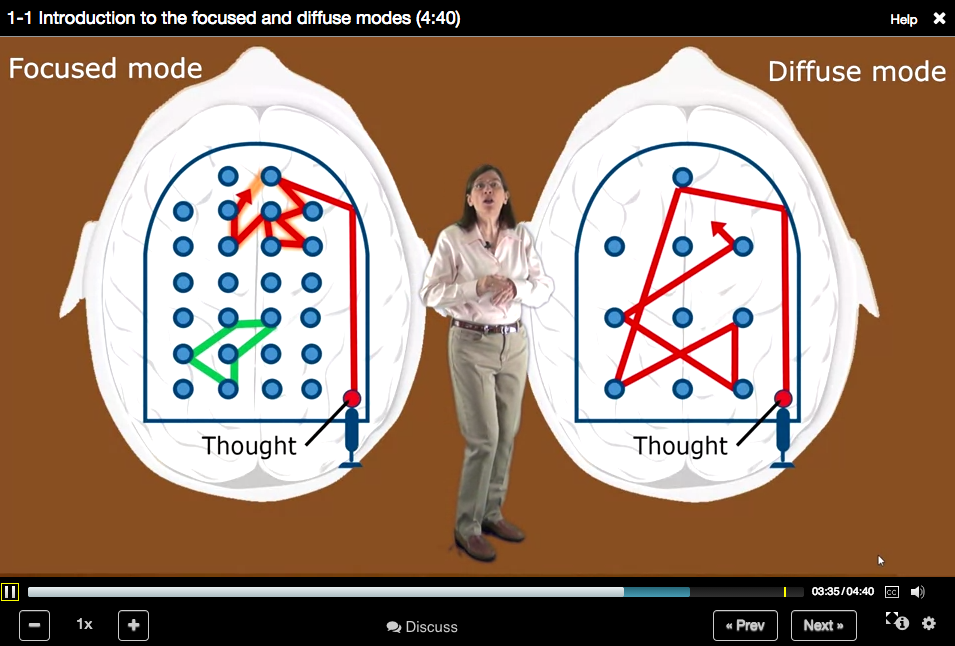
Using the analogy of pinball machines, focused mode has tighter bumper that keep thoughts concentrated and diffuse mode have looser bumpers that aid in more broad-ranging thinking.
Focused: Familiarity (textbook)
Diffuse: Broad-range, dealing with new things, creativity
AS A SUMMARY OF THE 1st MODULE OF LEARN HOW TO LEARN WITH COURSERA
- To activate the diffuse mode, sleep or go for a walk, just relax. The trick is to focus and then relax to let things settle and process.
- It always takes time to build a foundation.
- Patterning procrastination is important in practicing focused and diffuse mode. Practice to make permanence is important in dealing with more abstract topics.
- Long term memory is a huge trustworthy storage unlike working memory which is like a blackboard (erasable). If you work your working memory repetitively, it can become long term memory.
- Never cramp all learnings in one day. The mind and neutrons need time to build a solid foundation.
- Exercise is valuable in improving our memory and ability to learn so that we can build new neutrons in our brains.
COURSERA : LEARN HOW TO LEARN. SLEEP FLUSHES OUT TOXINS FROM OUR BRAINS


COURSERA : LEARN HOW TO LEARN. PRACTICE MAKES PERMANENT
I have been reading up, listening to audiobooks really, about how we learn, the law of attraction and all that about the subconscious mind. And in this 1.5 chapter of the Coursera Learn how to Learn. It is true again. There is nothing about inborn talent. No one is born with talent so to speak. it is all about learning and practicing.


Subscribe to:
Posts (Atom)
